AI-Enabled Software Development Increases the Importance of Systems Engineering
As AI automates software production, systems engineering becomes the governing control plane that orchestrates both human engineers and AI development agents.
Governing AI-Driven Engineering Systems in the Era of Software-Defined Vehicles
Artificial intelligence is rapidly transforming software development. AI coding agents can now generate software, produce tests, analyze defects, and assist with verification activities at a scale and speed previously impossible with human-only teams. As a result, some observers assume that AI will reduce the importance of engineering disciplines and eliminate engineering roles and work.
In reality, the opposite is true.
As software production becomes increasingly automated, the importance of systems engineering increases dramatically. AI systems cannot operate effectively from loosely structured documentation or informal requirements. Instead, they depend on structured, machine-interpretable engineering specifications that define system intent, architectural constraints, safety boundaries, and operational behavior.
In complex domains such as Software-Defined Vehicles (SDVs), systems engineering becomes the governing control plane that orchestrates both human engineers and AI development agents.
1. The Historical Coordination Problem in Software Development
Over the last two or three decades, the primary challenge we were faced with was the explosion in lines of code in complex systems — sometimes hundreds of millions in a real complex system — and coordinating the large numbers of human developers that designed, wrote, and tested them.
Organizations building complex digital products — particularly in industries such as automotive, aerospace, and defense — often require hundreds or thousands of software engineers working simultaneously. Managing this complexity led to the widespread adoption of Agile development methods and Agile-at-scale frameworks.
These approaches helped organize large development teams around iterative delivery models:
- Product owners translating business intent into backlog items
- Development teams implementing functionality through short delivery cycles
- Continuous integration and testing practices
- Agile-at-scale frameworks coordinating dozens or hundreds of teams
Some might debate the ability to truly achieve Agile at scale, but few would debate the intent behind it. As organizations scaled their software development efforts, many struggled to coordinate these increasingly complex engineering systems effectively.
Experienced practitioners often played an important role in helping organizations adopt these methods. In some cases this meant directly performing specialized engineering work. In others it meant transferring operational knowledge to internal teams so organizations could scale their own development capabilities.
This pattern has repeated throughout the history of engineering.
Experts either do the work or teach others how to do the work.
What changes during technological transitions is not the existence of expertise, but the nature of the expertise and the capabilities and skills that organizations must learn and possess.
Today, that transition is occurring again.
2. AI Changes the Nature of Engineering Work
Modern AI-assisted development environments can already perform tasks that previously required large teams of engineers.
These include:
- Code generation
- Automated test creation
- Static and dynamic analysis
- Documentation generation
- Simulation and verification assistance
- Defect detection
As these capabilities improve, the role of software engineers does not disappear. Instead, it evolves.
AI systems are particularly effective at tasks where human developers historically make routine errors. These include syntactic mistakes, inconsistent implementation patterns, missed edge cases, or defects introduced simply through fatigue or the limited ability of any individual engineer to track every interaction within a large software system.
In these areas, AI systems can significantly reduce human error. Automated systems can maintain consistent coding patterns, continuously analyze dependencies across large code bases, and detect issues that might be missed by individual developers.
This does not eliminate human engineers. Instead, it shifts their focus toward responsibilities that require broader system awareness and judgment.
Software engineers increasingly move toward roles such as:
- Defining system behavior and intent
- Supervising AI-generated implementations
- Validating system-level correctness
- Designing integration strategies across subsystems
- Diagnosing unexpected system behavior
Rather than spending large portions of their time writing individual lines of code, engineers increasingly operate at a higher level of abstraction, guiding automated development systems and ensuring that generated implementations correctly realize system intent.
In this sense, AI reduces certain types of human error while elevating the importance of human engineering judgment.
The engineering challenge therefore shifts away from producing code and toward governing automated development systems.
3. Machine-Interpretable Engineering Specifications
AI-assisted development environments require engineering artifacts that can be interpreted by machines.
Traditional documentation — Word documents, PowerPoint presentations, and informal Agile stories — does not provide sufficient precision to guide automated development systems.
Instead, development increasingly relies on structured engineering specifications.
Examples include:
- Model-Based Systems Engineering (MBSE) models using SysML
- Interface definitions and system contracts
- Structured requirements models
- Behavior specifications expressed through BDD scenarios
- Model-based design artifacts such as Simulink models
- Safety constraints derived from regulatory standards
These artifacts form the bridge between human engineering intent and automated software production.
Rather than acting purely as documentation, they become machine-interpretable descriptions of system behavior.
Once these structured specifications exist, AI systems can generate large portions of the software implementation and associated test artifacts.
4. Systems Engineering as the Engineering Control Plane
As AI systems begin producing software artifacts, the role of systems engineering evolves.
Instead of primarily coordinating development teams, systems engineering becomes the governing layer that defines how automated development systems operate.
Systems engineering responsibilities increasingly include:
- Defining system architecture
- Specifying interface contracts
- Defining operational behavior
- Defining safety constraints
- Governing cross-domain integration
- Maintaining compliance with regulatory standards
These responsibilities define the boundaries within which AI-driven development systems operate.
In effect, systems engineering becomes the engineering control plane for AI-enabled development environments.
The control plane defines system intent, architectural structure, and safety constraints. AI systems operate within those constraints to generate software implementations.
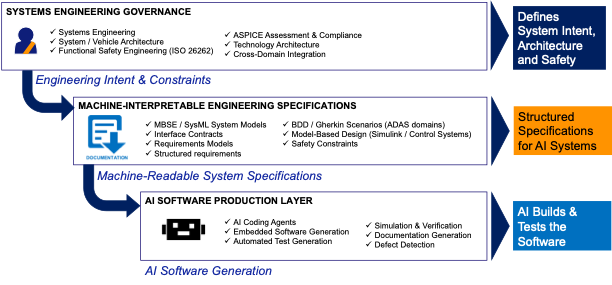
Figure 1 — Systems engineering defines the control plane governing AI-driven software generation, ensuring architectural integrity, safety constraints, and system-level behavior.
5. Human Authority in Regulated Engineering Domains
In safety-critical industries such as automotive, aerospace, and defense, engineering authority cannot be delegated entirely to automated systems.
Certain responsibilities remain inherently human:
- Functional safety engineering (ISO 26262)
- Cybersecurity engineering (ISO 21434)
- ASPICE process assessment
- Regulatory certification
- System-level validation and release approval
These responsibilities require certified professionals and organizational accountability.
AI systems may assist with analysis and artifact generation, but they cannot assume legal or regulatory responsibility for safety-critical systems.
As a result, the introduction of AI development systems increases the importance of qualified systems engineers, safety engineers, and architectural authorities.
6. The Coordination Shift in Engineering
In industries such as automotive, this shift is particularly visible.
Modern vehicles can contain hundreds of embedded controllers (and yes, huge efforts to redesign the architecture to reduce as well as centralize and zone the vehicle control systems) and well over one hundred million lines of software code distributed across multiple domains including propulsion, vehicle dynamics, body systems, connectivity, safety systems, and advanced driver assistance systems.
Managing this complexity required coordinating large teams of engineers working simultaneously across many subsystems.
Agile development methods and Agile-at-scale frameworks emerged largely to address this coordination problem.
However, as AI coding agents increasingly generate portions of software implementations and associated test artifacts, engineering organizations are no longer coordinating only human development teams.
Instead, they must govern hybrid ecosystems composed of human engineers and AI development agents.
The coordination challenge therefore shifts from organizing large numbers of developers to orchestrating automated engineering systems while maintaining architectural integrity, safety compliance, and system-level correctness.
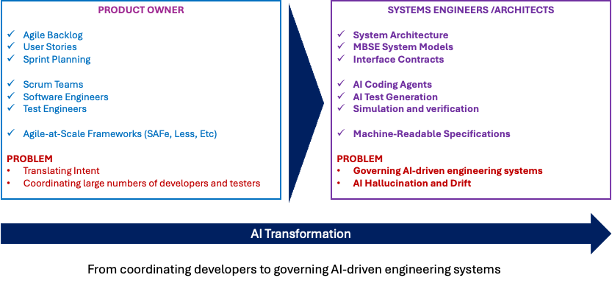
Figure 2 — Engineering coordination shifts from organizing large numbers of developers to governing AI-driven engineering systems composed of both human engineers and AI agents.
7. Implications for Software-Defined Vehicle Development
Software-defined vehicles represent one of the most complex development environments in modern engineering.
A single vehicle platform may contain:
- Hundreds of embedded controllers (although OEMs are actively redesigning vehicle architectures to consolidate these through centralized and zonal compute architectures)
- Millions of lines of software
- Distributed control systems
- Complex safety requirements
- Over-the-air software update infrastructure
These systems combine multiple development paradigms including software engineering, control systems engineering, safety engineering, and hardware/software integration.
As AI-assisted development tools mature, the ability to generate software automatically will increase significantly.
However, the complexity of the overall system will continue to require strong architectural governance.
Systems engineering therefore becomes the discipline that defines how automated development systems interact with vehicle architectures, safety constraints, and operational behaviors.
8. Conclusion
Artificial intelligence will dramatically accelerate the production of software.
However, this does not eliminate the need for software and systems engineering. Instead, it elevates the importance of systems engineering.
AI systems can generate code, tests, and documentation, but they cannot define system intent, architecture, safety or security boundaries.
Those responsibilities remain fundamentally human.
In AI-enabled engineering environments, systems engineering becomes the governing control plane that defines how automated development systems operate.
The future of engineering will not eliminate software and systems engineering.
It will depend on it.
At the same time, organizations must recognize that adopting AI-assisted development is not simply a matter of introducing new coding tools. Engineering methods, engineering artifacts, and engineering platforms must evolve together.
If engineering systems remain optimized only for human interaction while AI agents increasingly participate in development activities, the benefits of AI-enabled engineering will be severely constrained.
Organizations that modernize their engineering platforms to support both human engineers and AI-driven development systems will gain significant advantages in development speed, system reliability, and architectural consistency.
Those that fail to evolve their engineering environments may find that the real bottleneck in AI-enabled development is no longer the production of software, but the engineering systems used to manage it.
David Rush is an Engineering Thought Leader, Systems Engineering Practitioner, Process Methodologist, and Engineering Transformation Advisor with nearly five decades of experience in regulated product development across automotive, aerospace, medical devices, and critical infrastructure.